

At Tribeat, many of our projects involve designing architecture and choosing technologies from scratch. We work side by side with clients throughout the entire process — from identifying business challenges to implementing the right technical solutions.
In the early stages of projects, clients often bring us high-level issues such as:
- “Our business isn’t scaling the way we expected.”
- “User behavior has changed, but our existing systems can’t keep up.”
Our BizDev team then helps define the direction for systems and services, while our engineering team designs the optimal architecture from a technical perspective.
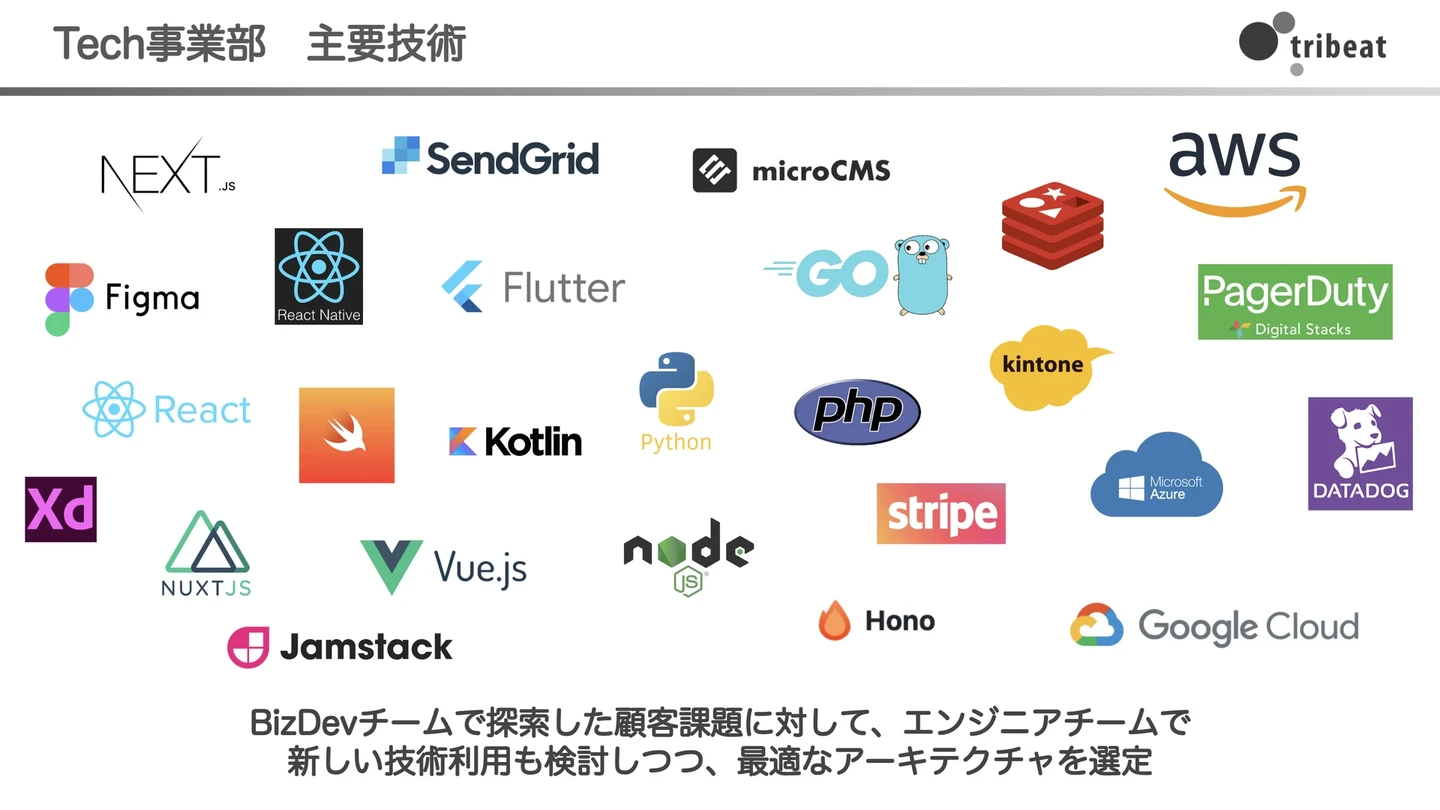
(Alongside this article, we’ve also published a visual overview of the main technologies used by the Tech Division — feel free to check it out.)
How We Approach Technology Selection
Technology selection is usually led by a project’s Tech Lead, but less-experienced members also join from the very start of the discussion. We do this for two main reasons:
- Sharing knowledge to raise overall technical capability
By exposing more people to the decision-making process and the criteria for evaluating options, the selection stage itself becomes a learning opportunity for the whole organization. In many large companies, this phase is reserved for senior engineers — but we deliberately keep it open. - Helping members adapt faster to projects
When engineers already understand the reasoning behind technology choices, onboarding becomes much smoother. Knowing “why this technology was chosen” provides essential context, leading to better implementation and long-term operations.
What Guides Our Choices
When selecting technologies, we don’t chase novelty or hype. Instead, we focus on the original problems the technology was created to solve. Cutting-edge tech isn’t always the best fit — but if its background aligns with the challenges we’re facing, we actively consider it.
As a result, we often do adopt the latest technologies when they make sense.
Continuous Involvement After Release
For us, a project doesn’t end at release — that’s when it truly begins. Since we’re often involved in long-term improvement post-launch, the tools and technologies we work with span a wide range.
This variety can be a challenge for engineers, but it also translates directly into growth and expanding expertise.
To prevent work from becoming dependent on any one individual, we emphasize knowledge sharing and maintain strong technical documentation. This ensures everyone can safely explore new areas of technology while relying on the support of the team.
/assets/images/1109600/original/ad91694b-46b6-4863-823c-38a061e77460.png?1484705642)


/assets/images/1109600/original/ad91694b-46b6-4863-823c-38a061e77460.png?1484705642)


/assets/images/21858564/original/ad91694b-46b6-4863-823c-38a061e77460.png?1755662147)