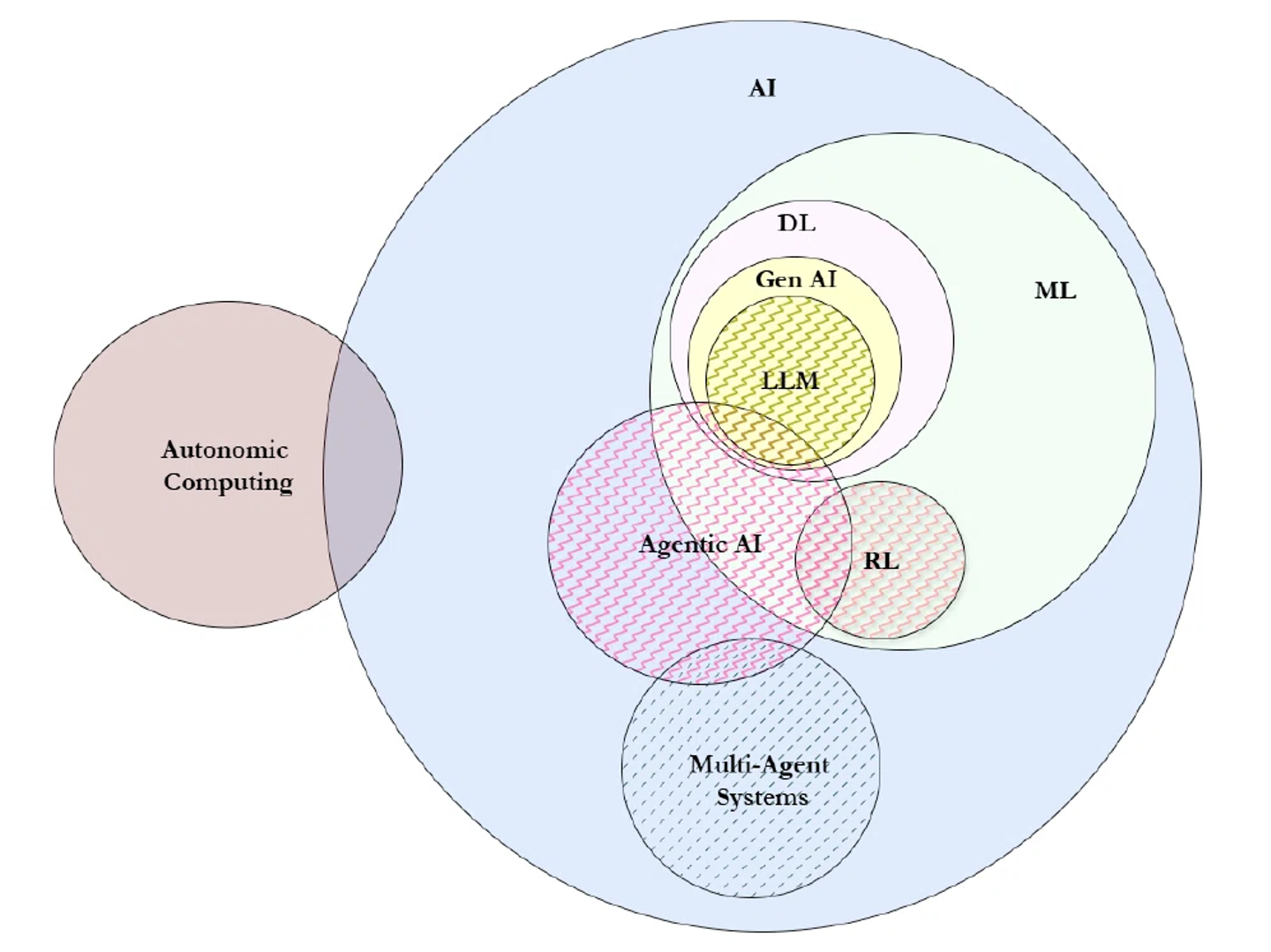
AIエージェントが急速に普及した背景には、LLMの飛躍的な進歩があります。従来のAIは特定のタスクに限定されていましたが(マルチエージェントシミュレーションなど)(Akuma et al., 2025)、LLMという汎用的な「頭脳」を得たことで、自律的に思考し行動する存在へと進化しました(Liu et al., 2025)。
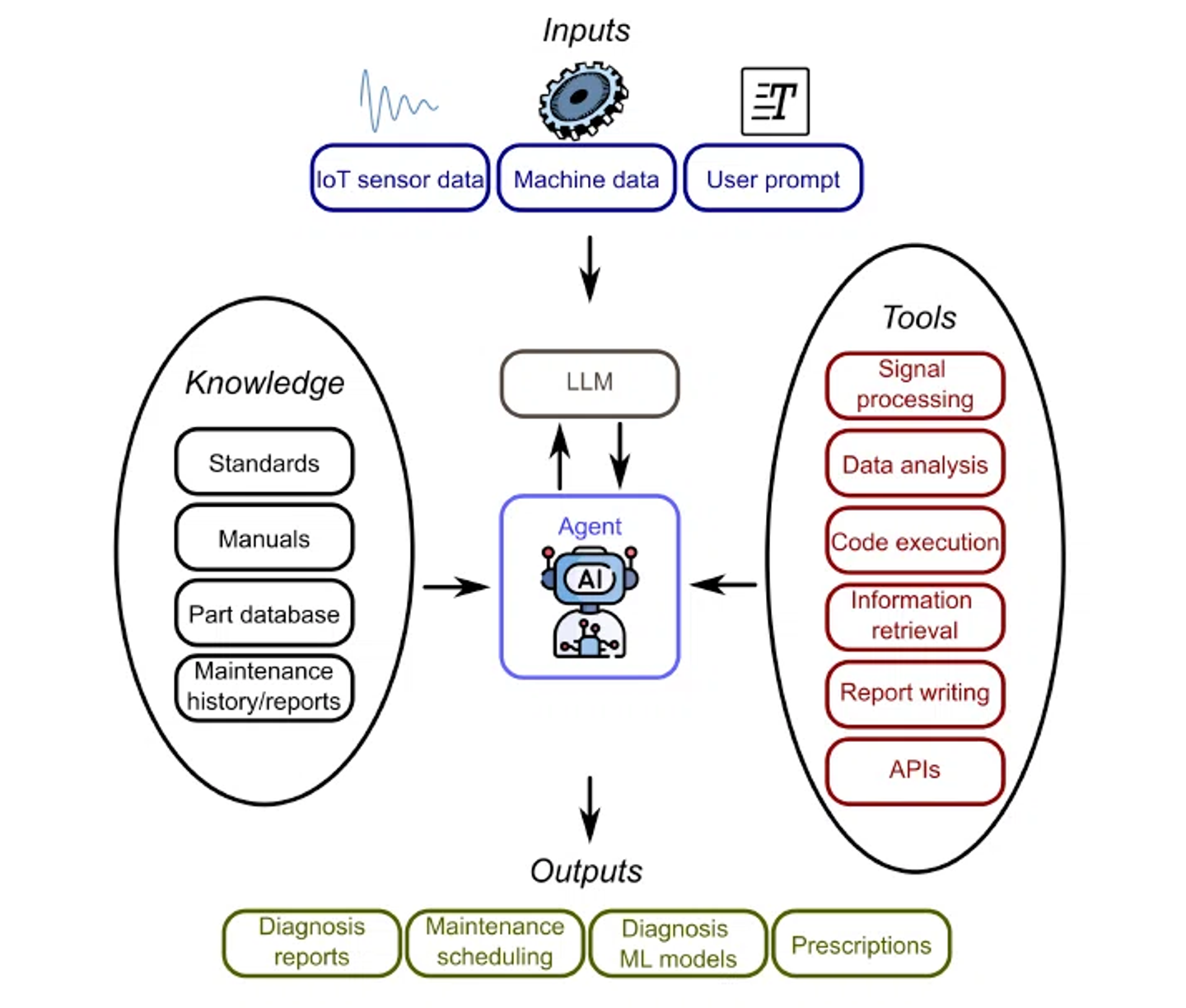
現代のAIエージェント(特にLLMベースのエージェント)は、一般的に以下の4つの主要コンポーネントで構成されるシステムとして定義されます(Bandi et al., 2025; Di Maggio, 2025; Liu et al., 2025)。
① 脳(Brain)
推論と意思決定の中枢であり、LLMがこの役割を担います。ユーザーからの指示や環境からの情報を理解し、知識を検索し、タスクを遂行するための計画(プランニング)を立て、最終的な意思決定を行います。LLMの進化により、単なるテキスト生成だけでなく、論理的な推論や複雑なタスクの分解が可能になりました(Akuma et al., 2025; Di Maggio, 2025)。
長期記憶: ベクトルデータベース(Vector DB)などを活用し、膨大な過去の経験や知識を永続的に保存します。RAG(検索拡張生成)技術を用いて、必要な時に適切な情報を検索・取得(Retrieve)することで、長期間にわたる学習や一貫した振る舞いを実現します(Liu et al., 2025)。
AIエージェントの実行プロセス
AIエージェントは、以下のサイクルを繰り返すことでタスクを完遂します。このプロセスはReAct(Reason + Act)やOODAループ(Observe-Orient-Decide-Act)とも言われます(Akuma et al., 2025; Bandi et al., 2025; Karim, Khan, et al., 2025; Karim, Van, et al., 2025)。
Akuma, C. F., Hewage, P., Garg, A., & Amaechi, C. V. (2025). AI agents: A comprehensive review of evolution, architectures, applications, and future directions. 2025 12th International Conference on Reliability, Infocom Technologies and Optimization (Trends and Future Directions) (ICRITO), 1–5.
Bandi, A., Kongari, B., Naguru, R., Pasnoor, S., & Vilipala, S. V. (2025). The rise of agentic AI: A review of definitions, frameworks, architectures, applications, evaluation metrics, and challenges. Future Internet, 17(9), 404.
Di Maggio, L. G. (2025). Toward autonomous LLM-based AI agents for Predictive Maintenance: State of the art, challenges, and future perspectives. Applied Sciences (Basel, Switzerland), 15(21), 11515.
Ferrag, M. A., Tihanyi, N., Hamouda, D., Maglaras, L., Lakas, A., & Debbah, M. (2025). From prompt injections to protocol exploits: Threats in LLM-powered AI agents workflows. ICT Express. https://doi.org/10.1016/j.icte.2025.12.001
Ganesh, S., Ardon, L., Borrajo, D., Garg, D., Sehwag, U. M., Narayanan, A. L., Canonaco, G., & Veloso, M. M. (2025). Generative AI agents for knowledge work augmentation in finance. Annual Review of Control, Robotics, and Autonomous Systems, 8(1), 189–210.
Gao, J., Qiao, H., & Zhang, Y. (2024). Intelligent recognition of tool wear with artificial intelligence agent. Coatings, 14(7), 827.
Gao, S., Fang, A., Huang, Y., Giunchiglia, V., Noori, A., Schwarz, J. R., Ektefaie, Y., Kondic, J., & Zitnik, M. (2024). Empowering biomedical discovery with AI agents. Cell, 187(22), 6125–6151.
Hettiarachchi, I. (2025). Exploring Generative AI Agents: Architecture, Applications, and Challenges. Journal of Artificial Intelligence General Science (JAIGS) ISSN:3006-4023, 8(1), 105–127.
Karim, M. M., Khan, S., Van, D. H., Liu, X., Wang, C., & Qu, Q. (2025). Transforming data annotation with AI agents: A review of architectures, reasoning, applications, and impact. Future Internet, 17(8), 353.
Karim, M. M., Van, D. H., Khan, S., Qu, Q., & Kholodov, Y. (2025). AI agents meet blockchain: A survey on secure and scalable collaboration for multi-agents. Future Internet, 17(2), 57.
Liu, F., Niu, Y., Zhang, Q., Wang, K., Dong, Z., Wong, I. N., Cheng, L., Li, T., Duan, L., Li, K., Li, G., Hou, T. W., Fok, M., Luo, H., Chen, X., Zhang, K., & Yin, Y. (2025). A foundational architecture for AI agents in healthcare. Cell Reports. Medicine, 6(10), 102374.
Market. us. (2025). AI Agents Market size, share, trends | CAGR of 43.8% [Dataset]. https://market.us/report/ai-agents-market/
Sapkota, R., Roumeliotis, K. I., & Karkee, M. (2025). AI Agents vs. Agentic AI: A Conceptual Taxonomy, Applications and Challenges. In arXiv [cs.AI]. arXiv. http://arxiv.org/abs/2505.10468
Zhou, Z., Zhang, H., Song, C., Ming, C., & Sun, Y.-Y. (2025). Construction of an artificial-intelligence agent for the discovery of next-generation white-LED phosphors. Physical Chemistry Chemical Physics, 27(43), 22885–22893.


/assets/images/23233681/original/e9d2a4b2-66ea-4f35-bb4c-f126562db55c?1773021054)


/assets/images/23233681/original/e9d2a4b2-66ea-4f35-bb4c-f126562db55c?1773021054)

/assets/images/23233681/original/e9d2a4b2-66ea-4f35-bb4c-f126562db55c?1773021054)