Hi — the recruitment team at At Inn here.
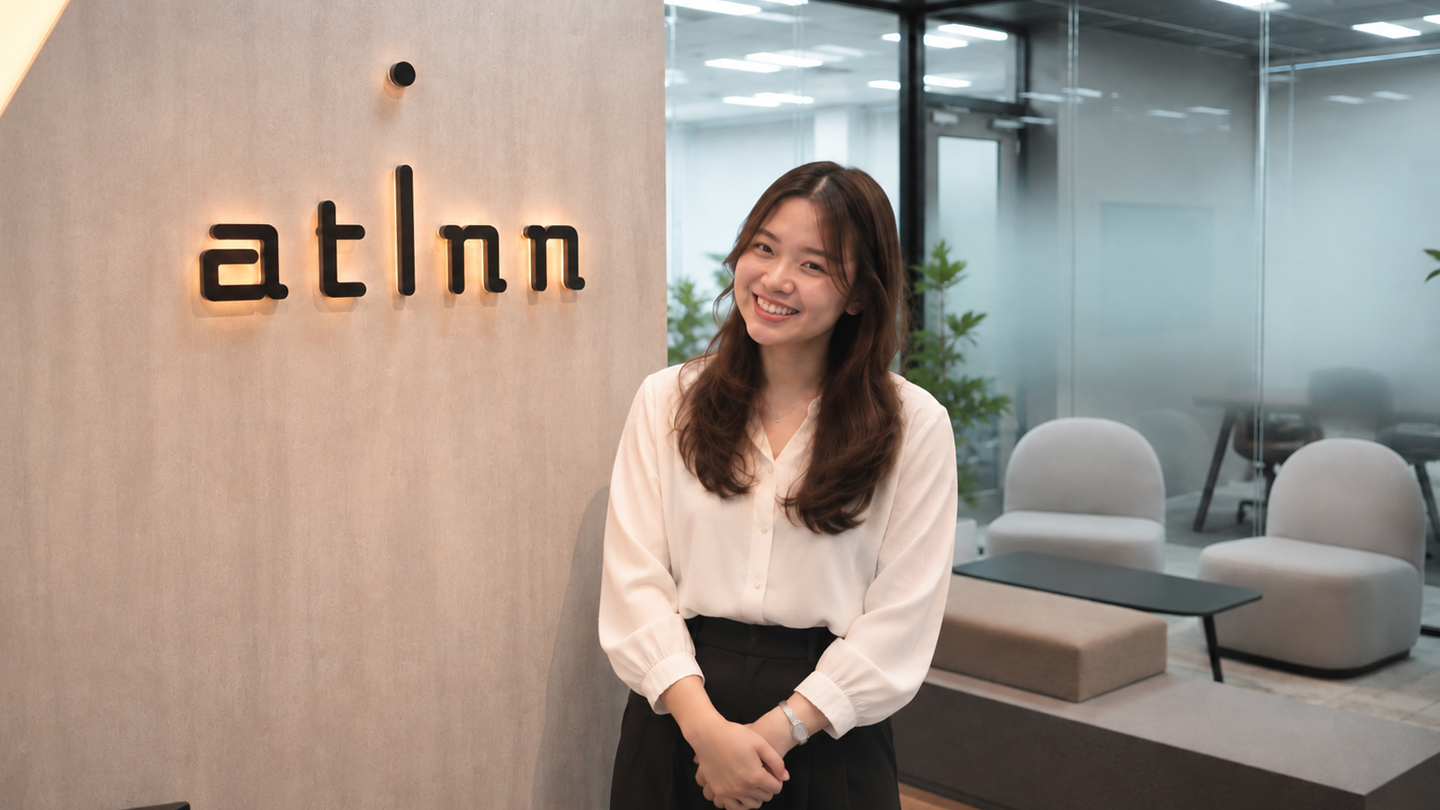
For this employee story, we sat down with Sumarni of our Cross Border Relocations Japan (CBRJ) team, where she helps international professionals get their new lives in Japan off the ground.
Picture trying to find an apartment in a city where you don't speak the language. Or standing in a city hall lobby with no idea which counter is yours or which of the forms on the wall you're supposed to fill out. Anyone who's started over in Japan knows that particular flavor of lost.
When Sumarni moved from Indonesia for university, she ran into all of it — the language barrier, the paperwork, the everyday things nobody explains. That's exactly why she went into this work: so that other people taking their first steps here wouldn't have to do it alone.
Today, she aims to be the first person they can turn to.
We asked her about the experiences that shaped her, what drew her to At Inn, and what it really takes to help someone feel at home in Japan.
Profile
Sumarni
Originally from Indonesia, Sumarni is in her sixth year in Japan and her third at At Inn, which she joined straight out of university.
Her connection with the country started in sixth grade, when she lived here with her family. After finishing high school back in Indonesia, she returned to Japan for university, studying international law in the Faculty of International Relations.
She spent most of her student life in an English-speaking environment and passed JLPT N1, the highest level of the exam — then found out how little textbook Japanese resembles the real thing. Finding an apartment and getting through the admin of daily life in an unfamiliar country turned out to be just as hard.
Those experiences are what brought her to At Inn.
Today she supports engineers and other skilled professionals relocating to Japan, from finding them a home to walking them through registration at city hall and setting up a bank account — everything it takes to get a new life started.
Passing a Japanese Exam and Speaking Japanese Are Two Different Skills
Q. What brought you to Japan in the first place?
Childhood memories, really. I never forgot the streets, the way things looked, the feel of the place — and part of me always assumed I'd find my way back.
The first time I lived here I was in sixth grade. My mother came to do research at a graduate school, so the whole family moved with her. Those years stayed with me.
Once her research finished we went back to Indonesia, and I graduated from high school there. When it came time to decide what was next, my mind kept going back to the places I remembered.
The pull got strong enough that I decided to do my degree here.
Q. What was university like?
I studied international law in the Faculty of International Relations. I could do all my coursework and talk with my friends in English, which meant I barely spoke Japanese day to day.
I'd already passed JLPT N1, the top level of the exam. It didn't take long to learn that clearing a language test and actually living in the language have almost nothing to do with each other.
I could read a sentence in a textbook and understand it perfectly. Then I'd open my mouth in a real conversation and the words just wouldn't arrive fast enough.
That was frustrating. I was living in Japan without feeling like I was really part of it.
Step outside the English-speaking bubble of my university and I was handling the language and the cultural gaps on my own. Living independently here was the hardest part by far.
"I Just Wanted Someone There With Me"

Q. What were the biggest hurdles once you were living on your own?
Two things: finding somewhere to live, and getting through city hall.
I arrived excited, and reality showed up fast. I had no idea where to look for an apartment, which counter at city hall I needed, or what order any of it was supposed to happen in.
Everyone knows they need a place to live before anything else can start. But the paperwork side is genuinely bewildering when there's nobody next to you to say "start here."
I still remember standing alone in a city hall lobby, somewhere unfamiliar, where nobody spoke my language.
All I could think was how much easier this would be if one person were here to walk me through it.
That feeling — lost, on my own, wishing for someone — is where the work I do now comes from.
Turning a Hard Experience Into Something Useful
Q. How did you come across CBRJ during your job search?
I was still unsure what kind of career I wanted when I found a posting online for CBRJ, a service supporting people relocating to Japan.
Reading it, my first thought was: this is the job I'm supposed to be doing.
I was about to graduate, with no work experience and zero knowledge of real estate. But the moment I saw it involved helping international residents get set up here, it was obvious that what I'd been through could actually be worth something.
I'd struggled with the housing and the paperwork myself, so I knew how it feels to be on that side of the counter.
I wanted to be there for people facing the same thing, so I applied without overthinking it.
Q. Plenty of companies offer relocation support. Why At Inn?
Because here I could support people's daily lives and learn real estate properly, from scratch.
During my job hunt I applied to two companies in the settling-in support space. With both of them, I struggled to picture what the work would actually look like day to day, and that made me hesitate.
At Inn was different. Alongside the lifestyle support, the company runs a whole range of its own real estate services, including monthly furnished apartments.
Housing is usually the first real wall people hit when they move here. Screening and rental contracts are especially tough for non-Japanese residents, and translating the words on the page doesn't make that wall go away.
With actual real estate knowledge, you can negotiate properly with management companies and keep clients out of contract trouble before it starts.
I felt At Inn would let me be more than a sympathetic voice or an interpreter — I could become a professional who solves the problem.
That's what decided it for me.
More Than an Interpreter: Being the First Person Someone Can Call

Q. What's your role on the CBRJ team today?
I handle the whole journey, so that people moving here for work can start with confidence from day one.
A lot of our clients are highly skilled engineers and other specialists hired by major Japanese manufacturers and IT companies. They're experts in their fields — and then they land here and the ordinary parts of daily life are suddenly a question mark.
That's where we come in.
Before they fly, we find them a home. Once they've moved in, we show them how the air conditioner and water heater work. We go with them to register their address at the ward office and to open a Japanese bank account.
Start to finish, we're with them while they build the foundations of life here.
Q. Housing, paperwork, everything in between — what matters most to you in this work?
I want to be the first person a client knows they can call.
Interpreting matters, but I don't want the job to stop at translation. I want to be the person who turns "I have no idea what's happening" into "okay, I've got this."
When I arrived as a student, I couldn't get my Japanese out and I didn't know who to ask for help. I remember exactly how exposed that felt.
When you're building a life somewhere with unfamiliar rules and a different culture, just having one person nearby you can ask anything — however small — changes everything.
So I try to be the person I was looking for back then.
That's the part of this job we're proud of at At Inn.
In Part 1, Sumarni told us about the experiences that pushed her toward this work and brought her to At Inn.
In Part 2, we get into the day-to-day.
She walks us through a field support day — the kind that has you crossing the city from morning to evening — and explains why the paperwork has to happen in a particular order, and how she helps clients make sense of life here without ever falling back on "that's just how it works in Japan."
We also talk about how she bridges cultural gaps so that clients feel heard, respected, and genuinely informed.
What does it actually mean to be someone's first ally in a new country?
Read Part 2 for the care and know-how behind Sumarni's work.
/assets/images/24690216/original/a41055d8-7d5b-4459-a99d-85f513666f62?1790070954&w=1440)
/assets/images/3707340/original/34c4b075-7055-48d5-80c0-9ae597da0f5c?1643016571)

/assets/images/3707340/original/34c4b075-7055-48d5-80c0-9ae597da0f5c?1643016571)

/assets/images/3707340/original/34c4b075-7055-48d5-80c0-9ae597da0f5c?1643016571)